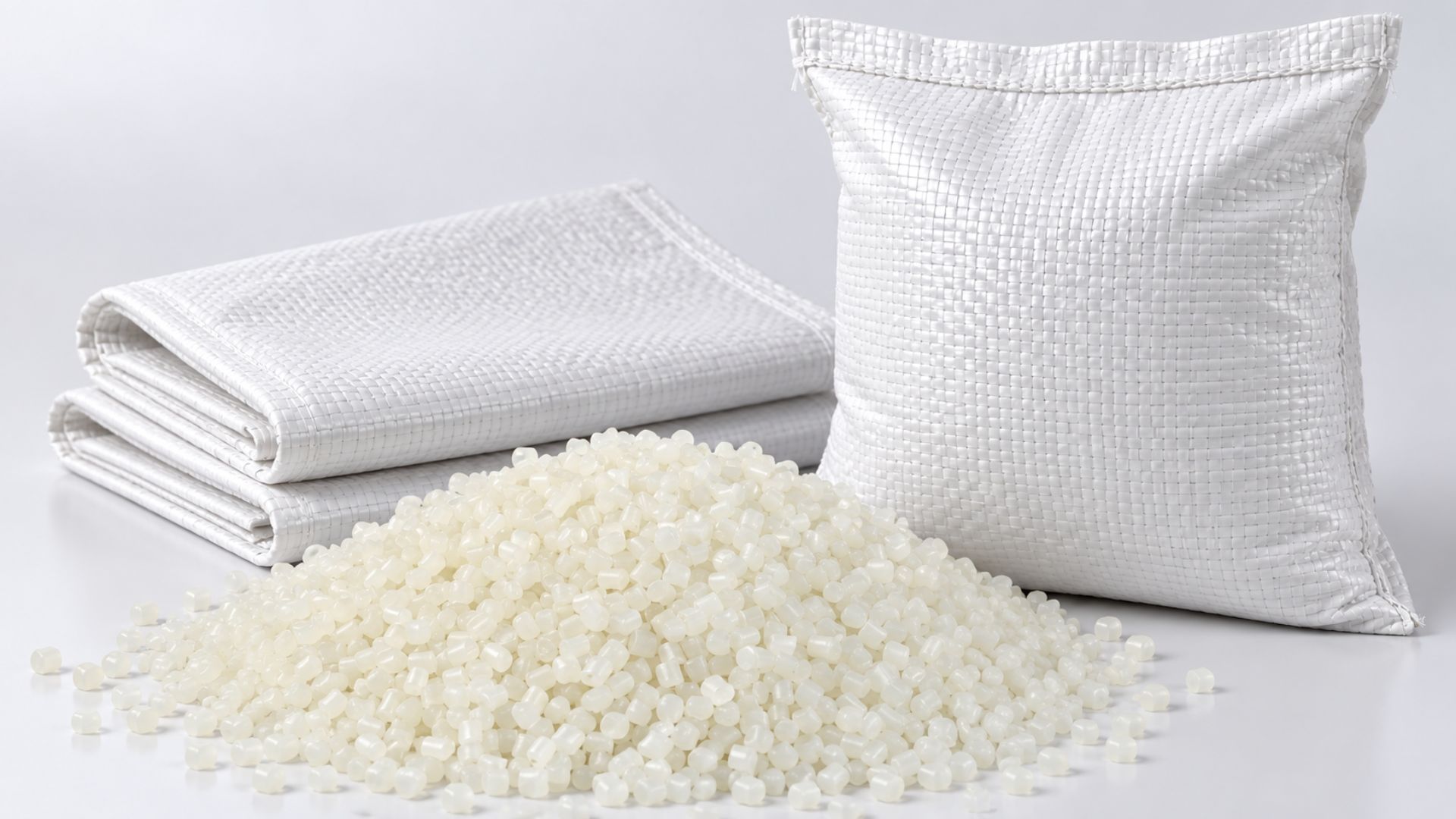
Surface friction affects how woven bags move through equipment, interact with other bags, and behave during handling and storage. Slip masterbatch for woven bags helps control this friction, but its suitability depends on the material, bag structure, and processing conditions. This CVN PLASTICS blog explains its working principles, applications, and selection criteria to help readers understand the technical factors behind its performance.
What Is Slip Masterbatch For Woven Bags?

Slip masterbatch for woven bags is a concentrated additive formulation used to modify surface friction in a suitable polymer layer. It contains a slip agent dispersed in a carrier resin. Its purpose is to provide a controlled level of slip while maintaining the properties required for processing and final use.
Main Components
The carrier resin allows the active ingredient to be incorporated into the polymer formulation in pellet form. Its compatibility and processing characteristics influence how the masterbatch mixes with the base material. For slip masterbatch for woven bags, consistent dispersion is important because uneven additive distribution can produce uneven surface performance.
Common migrating slip agents include fatty acid amides such as erucamide and oleamide. Other formulations use non-migrating technologies to provide different friction characteristics. The appropriate chemistry depends on where the additive is used, how the material is processed, and whether its surface will undergo printing, coating, or lamination.
How It Works
Migrating slip agents move through the polymer toward its surface, where they form a thin lubricating layer. This layer reduces resistance to sliding between contacting surfaces. Cargill describes this surface migration as the basis of conventional slip additive performance in polymers.
The performance of slip masterbatch for woven bags is commonly assessed through the coefficient of friction, or COF. Under comparable test conditions, a lower COF indicates less resistance to sliding. Non-migrating systems use a different approach to surface modification and may provide more stable friction performance in suitable applications.
Why Use Slip Masterbatch In Woven Bag Production?
Lower Surface Friction
Slip masterbatch for woven bags can reduce friction at the surface of the layer containing the additive. The practical effect depends on which surfaces contact each other during production or use. Friction between polymer and metal, for example, may differ from friction between two finished bags.
This distinction matters in multilayer structures. An additive incorporated into PP tapes does not automatically determine the friction of an outer coating or laminated film. The exposed surface, its texture, and the materials in contact all contribute to the measured result.
Easier Material Handling
Controlled friction can support material movement during suitable processing and handling operations. Slip masterbatch for woven bags may help address excessive resistance where the selected formulation reaches the relevant contact surface. Any improvement remains dependent on equipment conditions, material structure, and the original cause of the handling problem.
Lower friction does not automatically produce higher output or fewer defects. These outcomes require production evidence. Excessive slip can also reduce the traction needed for feeding or guiding material, so the useful operating range must be established through trials.

Controlled Slip Performance
The objective of slip masterbatch for woven bags is a suitable friction level throughout the required production and storage period. The lowest possible COF is not necessarily the best result. Finished bags also need sufficient resistance to unwanted movement during transport and stacking.
Bag-to-bag friction is particularly relevant after filling. Bag shape, filling material, surface condition, and stacking arrangement influence stability. A formulation that performs well during conversion therefore still requires evaluation on filled bags under representative conditions.
Where Can Slip Masterbatch Be Used?
PP Tapes And Woven Fabric
When slip masterbatch for woven bags is considered for PP tapes, its suitability must extend beyond surface feel. Tape production involves extrusion, stretching, and winding, so the formulation must remain compatible with these operations. Trials need to assess tape consistency, tensile properties, elongation, and weaving performance.
The resulting fabric surface also depends on tape dimensions and weave structure. These physical features influence contact between surfaces and can affect apparent slip. A masterbatch intended for film applications cannot be assumed suitable for stretched PP tapes without supporting technical information.
Coatings And BOPP Films
In coated or BOPP-laminated bags, the outer layer often governs contact with equipment and adjacent bags. Selecting slip masterbatch for woven bags therefore requires a clear understanding of the surface that needs modification. The additive location is especially important when different sides perform printing and bonding functions.
Some BOPP systems use slip additives in specific surface layers. Their suitability depends on film design and subsequent conversion. Ampacet offers both migrating and non-migrating slip technologies within its BOPP additive portfolio, illustrating the need for application-specific selection.
PE Inner Liners
PE liners have separate handling requirements from the woven outer bag. Slip masterbatch for woven bags may be relevant to the liner when controlled friction supports opening, insertion, or filling operations. The selected grade must suit the PE formulation and liner production process.
Liner evaluation also includes blocking and sealing behaviour. A film that slides easily may still be difficult to separate if its layers adhere during storage. Slip and antiblock performance therefore require separate consideration, even when both functions are supplied in one formulation.
How To Choose The Right Slip Masterbatch
Match The Carrier Resin
The carrier resin must be suitable for the base polymer and intended processing conditions. For slip masterbatch for woven bags, selection also involves the carrier’s effect on mixing, stretching, and final material properties. Compatibility cannot be judged only from a general statement that a product is suitable for polyolefins.
Technical assessment should consider the complete formulation, including fillers, pigments, and other additives. Changes in these components can alter dispersion and surface behaviour. A grade proven in one formulation may require further validation when the material composition changes.
Check Slip Development Over Time
The performance of slip masterbatch for woven bags can change after production, particularly when the active ingredient migrates to the surface. An immediate measurement may therefore differ from a measurement taken after storage. Temperature and the time between manufacturing and use are relevant evaluation conditions.
Useful comparisons include measurements at defined intervals that reflect the actual supply chain. This approach helps identify whether the friction level remains within the required range. Consistent conditioning and measurement conditions are necessary for meaningful comparisons between samples.
Consider Printing And Lamination
Slip additives present at a surface can affect subsequent conversion, depending on their chemistry and concentration. Selecting slip masterbatch for woven bags requires attention to the printed surface, bonding interface, and storage period before conversion. Surface treatment does not remove the need for compatibility testing.
Product limitations can be specific. For example, Starpoly states that its SANSLIP-01 grade is not recommended for products requiring printing because surface migration may affect print quality. This restriction concerns that particular grade and should not be generalized to every slip formulation.
Technical Data
Relevant technical information includes carrier resin, intended applications, recommended addition rate, and active content where disclosed. For slip masterbatch for woven bags, COF data are more useful when the supplier also identifies the substrate, dosage, conditioning period, and measurement conditions.
Dosage must be interpreted alongside active concentration. For example, a masterbatch containing 10% active ingredient, used at 1% of the final mixture, contributes 0.1% active ingredient, or 1,000 ppm. This calculation illustrates concentration only and does not establish a recommended dosage.
Slip Masterbatch Vs Antiblock And Anti-Slip
These additive categories address different surface problems. Slip masterbatch for woven bags is intended to reduce sliding resistance, whereas antiblock and anti-slip solutions serve other purposes. The distinction helps prevent a handling problem from being matched with an unsuitable additive.
| Additive | Primary Function |
| Slip masterbatch | Reduces friction between contacting surfaces |
| Antiblock masterbatch | Reduces adhesion between adjacent film layers |
| Anti-slip additives | Increase surface grip or friction where required |
Antiblock additives commonly reduce close contact between film layers, while slip additives modify friction during sliding. Combined formulations are available, but each function still requires evaluation. Ampacet describes reduced film-to-film contact as the principal mechanism of its antiblock additives.
What To Test Before Full Production
Processing And Mechanical Properties
Production trials establish whether slip masterbatch for woven bags addresses the identified problem without compromising other requirements. Relevant observations include feeding behaviour, winding consistency, tape breaks, and process stability. Samples produced without the additive provide a useful reference when other conditions remain comparable.
Mechanical evaluation depends on the application. Tape and fabric testing may include tensile strength and elongation, while finished bags may require additional performance checks. Acceptance criteria should reflect the intended bag specification rather than surface slip alone.
Printing And Bond Strength
Printed samples require assessment of ink adhesion after appropriate drying or curing and, where relevant, storage. Laminated or coated structures also require bond evaluation. These checks help establish whether the selected additive concentration remains suitable for the complete bag structure.
Friction And Stacking Performance
Friction testing should identify the surfaces being compared and distinguish resistance at the start of movement from resistance during sliding. Measurements after defined storage periods help reveal changes over time. Filled-bag stacking trials provide additional evidence because flat material tests do not reproduce every condition encountered in service.
Conclusion
Slip masterbatch for woven bags provides a means of controlling friction in a defined part of the bag structure. Its performance depends on additive chemistry, carrier resin, dosage, surface location, and time after processing. Reliable selection combines technical data with production trials, surface testing, and evaluation of the finished bag under realistic conditions.
FAQs
1. Is Slip Masterbatch Suitable for All PP Woven Bags?
No. Suitability depends on the bag structure, friction requirements, and intended use.
2. Can Slip Masterbatch Affect Printing?
Yes. Certain formulations may affect print adhesion depending on the additive, dosage, ink system, and surface treatment.
3. Does More Slip Masterbatch Give Better Results?
No. Excessive dosage may reduce friction too much or affect printing, bonding, and stacking performance.
4. Can One Grade Be Used for PP Tapes and PE Liners?
Possibly, but compatibility and performance must be verified for each polymer and processing condition.